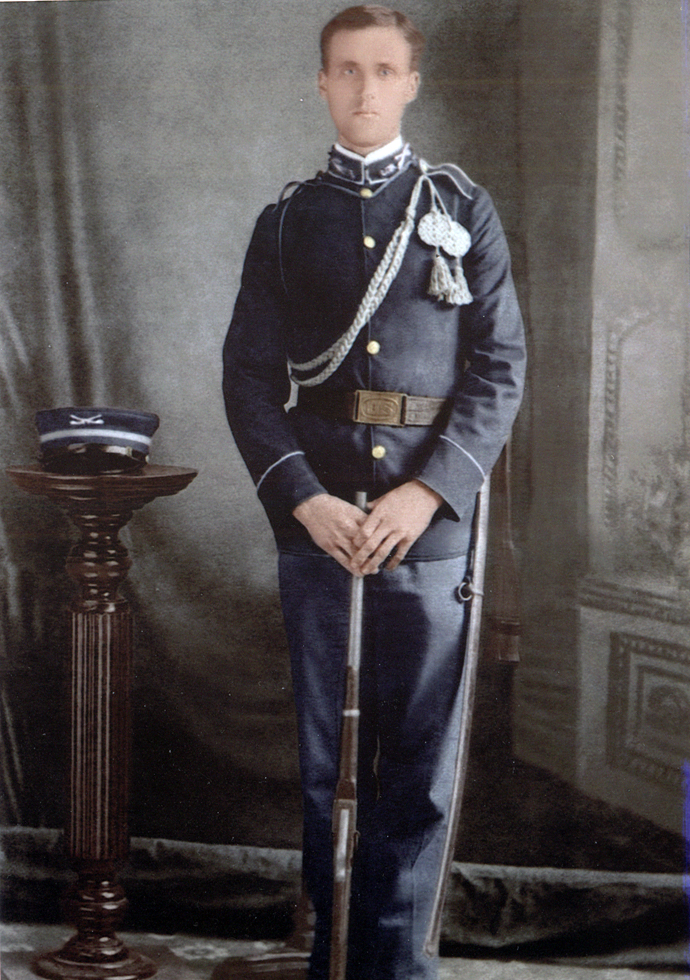
1998 Marks 100th Anniversary Of Short Spanish-American War
By Lewis G. Baker
This is a reprint of an article published by the Kentucky Explorer with the permission of the Author.
This article proves that many things in history which we have been led to believe are true, are not true!!!
The 6th Infantry Regiment from Fort Thomas, Kentucky was one of the five regiments to capture San Juan Hill. They brought home a Spanish cannon that is at the entrance of the former fort, where many World War II veterans of Kentucky put on their first uniform.
This year is the 100th anniversary of the Spanish-American War; Congress declared war on Spain, April 21, 1898. Fighting ended July 17th, and a peace treaty was signed December 10, 1898.
February 15th, the U.S. battleship Maine exploded and sank in Havana Harbor, Cuba. The cause was never determined, but U. S. newspapers and the 39-year-old assistant secretary of Navy, Teddy Roosevelt, put the blame on Spain. Spain didn’t want a war, and the United States Army wasn’t prepared for one. It was said, publisher William Randolph Hearst told artist Frederic Remington, “You furnish the pictures; I’ll furnish the war.” When President McKinley asked for volunteers, Teddy Roosevelt resigned his position to fight in the war.
I don’t intend to try to give a comprehensive account of the war. I would like to point out some false newspaper reports and artist depictions (like the one with this story), that has distorted the history of the war.
The Rough Riders were the U. S. 1st Volunteer Cavalry Regiment, assembled at San Antonio, Texas, under the command of Col. Leonard Wood, with Lt. Col. Teddy Roosevelt second in command. Roosevelt had been offered command of the regiment, but with no military experience declined the offer.
May 30th, with only three weeks of training, the Rough Riders were on their way to Camp Wilcox, Florida, in route to Cuba. Only two of their three squadrons went to Cuba. Only senior cavalry officers’ horses were taken to Cuba. Junior officers and enlisted men of all cavalry regiments were on foot.
San Juan Hill was steep, had tall grass, barbed wire, and trenches; hard to climb on foot. The Spanish couldn’t see the U. S. troops until they were near the top. There were no charges on horseback, against any enemy position; surely not on San Juan Hill. The Rough Riders were not one of the five regiments to capture San Juan Hill.
July 1st, U. S. troops captured the key positions protecting the city of Santiago. The hardest fighting was at the village of El Caney. A Negro regiment was the first to fight its way into the village. Negroes helped take every enemy position, and U. S. officers said they fought bravely. The Cuban freedom fighters held key positions near Santiago, detained 3,500 Spanish replacement troops, keeping them out of the fighting against U. S. troops. For some reason U. S. newspapers didn’t cover the accomplishments of the Negroes or Cubans, nor the hard fighting at El Caney. They must have all been following Teddy Roosevelt, a well-known, high-profile person, who resigned a high position to fight in the war. He got more newspaper coverage then the generals. I am not trying to discredit Teddy Roosevelt, by no means. He was a brave, intelligent person, who served his country well in a good number of positions.
If Lt. Col. Teddy Roosevelt and the Rough Riders didn’t capture San Juan Hill, what did they do? Remember, only Roosevelt was on a horse and one-third of the regiment was left in Florida. Every enemy position was attacked by four or five regiments, not one. There was a lot of confusion in the San Juan Heights, near San Juan Hill; regiments moving through other regiments; and troops getting mixed, most waiting on orders that never came down.
Lt. Col. Teddy Roosevelt was not in command of the Rough Riders. Col. Wood had been promoted. Roosevelt, the Rough Riders, and other troops were near the base of a hill, just to the right of San Juan, waiting on orders. Two regiments had attacked the hill, but were stalled. Roosevelt decided, since he was ranking officer in the area and no orders from above, he would take charge and lead an attack on the hill. He led an attack of Rough Riders and others, capturing the hill. The troops found a large kettle on the bill and called it Kettle Hill. Best I can determine, it didn’t have a name; may have been considered part of San Juan Hill. That one day of fighting was the majority of the ground war. More Americans lost their lives to typhoid and yellow fever than on the battlefields.
I am not trying to diminish the accomplishments of anyone. Like I said at the start, I just want to point out the things that distorted the history of the war. One thing our history books lack is balance. They exaggerate the accomplishments of some and don’t give due credit to others. I am sure some of you will take issue with me, but false information repeated for 100 years, seems to be considered fact. I have researched this information from many sources. You do the same and I am sure you will agree with me.
The U. S. Navy played a much greater roll in the war than the U. S. Army. The first battle was naval; May 1st. U. S. Commodore (later an admiral) George Dewey, destroyed the Spanish fleet in Manila Bay of the Philippines. July 4th, U. S. Commodore Winfield S.Scheley destroyed the remainder of the Spanish Navy, as they tried to escape the U. S. blockade of Santiago Harbor. That virtually ended the war. July 17th, the city of Santiago surrendered, which ended the fighting.
December 10, 1898, the U. S. and Spain signed a peace treaty in Paris, France. Spain ceded Guam and Puerto Rico to the U. S. Cuba was granted its independence. The U. S. paid Spain $20,000,000 for the Philippines, who were expecting their independence (The U. S. gave them their independence at the end of World War II, 1946.)
The Philippines soon started a revolt called the Philippine Insurrection, which lasted over three years, took over 4,000 American lives, wounded over 2,000, and cost over $600,000,000; thirty times what the U. S. paid for the Philippines.
My grandfather, Abner C. Baker of Booneville, Kentucky, in Owsley County, served in that war with the cavalry. They were fighting the Moro Tribes. He brought home a Moro sword, curved and in a bamboo scabbard. Most U. S. troops captured by the Moros died a gruesome, brutal death. It was a war with little public support, like the Vietnam War years later.
| advanced |